
Categories
Field Notes

Field Notes: Remembering School Integration

There is a time within memory when schools in America were segregated by race. Before 1954, the law of the land dictated that white children went to public schools and black children attended their own local and regional schools. Starting in 1955, public schools began the often painful process of bringing together black and white students in classrooms for the first time. Each community had its own story to tell. This is one of them.

In early 2022, students in Courtney Taylor’s Charleston, Missouri civics and history classes interviewed area residents with memories of this era.

As a new school year begins, it is worthwhile to listen to the recollections of these Missourians. Now community leaders and respected elders, these white and black men and women reflected on what it was like to experience segregation then integration in one small Missouri community.

These oral histories also make up a recent two-part episode of the podcast Mo’ Curious. Here are parts 1 and part 2 of that podcast.

If you are interested in histories of integration, you might also want to see this video about Chariton, County, Missouri’s former Dalton Vocational School.
Categories
Mo-Curious

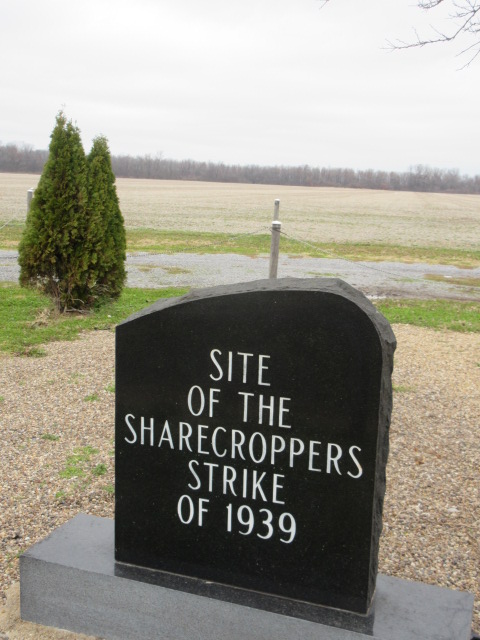
Mo’ Curious: The living legacy of Missouri’s dramatic 1939 sharecroppers’ strike (part 1)

Back in 1939, the world was a different place. For one thing, there were a lot more people involved in farming. In Missouri’s Bootheel region, this meant bodies were needed to grow cotton. Under the sharecropper model, those Missourians who grew cotton had no guarantees of a wage. They could be evicted anytime from the land on which they lived and worked.

In this episode of Mo’ Curious, we learn about the 1939 sharecroppers strike in Mississippi County, Missouri. It was on January 1 of that Depression year that Bootheel tenant farmers, or sharecroppers, participated in a protest. They camped on the roadside to draw attention to the deplorable economic and housing conditions that kept them impoverished and dependent.

For two months, fifteen hundred Missourians lived their lives on the side of Highway 60 between Sikeston and Charleston.

In order to bring a better understanding of the strike to area youth, we asked Charleston High School students to conduct oral history interviews. These interviews aimed to explain the strike and its legacy on the surrounding communities. Here is some of those exchanges.

Mo’ Curious by Missouri Life is a podcast about the past, present, and future of the 24th state. Hear other episodes at MoCurious.com.